
Finding Disconnects: How I find and bridge alignment gaps
My Growth Systems Approach
When growth slows down, where do you look first?
Most businesses immediately look at campaigns, channels, budgets, or performance reports.
I’ve learned that growth usually breaks much earlier. Before strategy, before execution, and often before marketing itself.
This page is a reflection of the questions, principles, and operating philosophy I use to uncover those hidden disconnects and build growth systems that last.
Where I Always Begin?
Marketing begins with clarity, not channels.
I don’t begin with channels, campaigns, or marketing tactics.
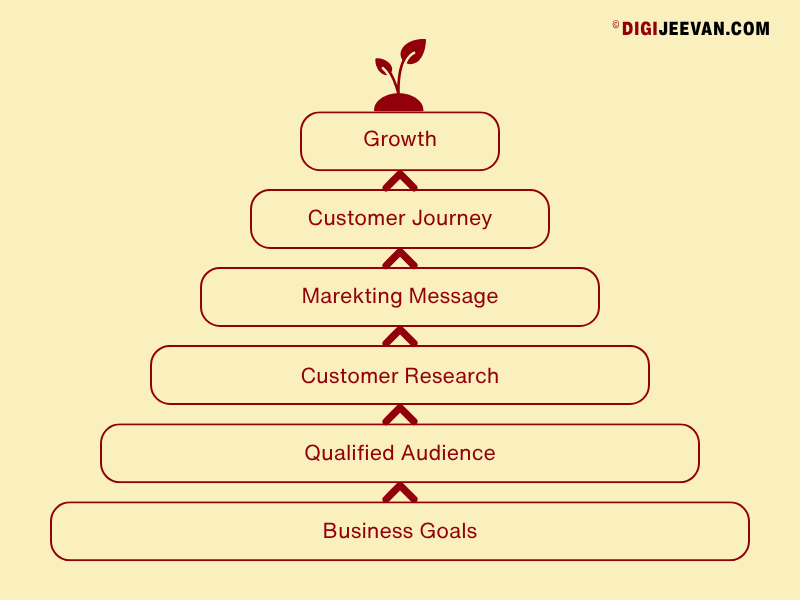
I begin by understanding what the business is trying to achieve, who actually influences that outcome, and what those people need before they’re ready to act.
The order matters.
If the business objective is to increase prescriptions for a specialist therapy, but the marketing effort is directed towards people who don’t influence prescribing decisions, every campaign that follows – even if it’s creatively brilliant and technically well executed – will struggle to create meaningful business impact. Strategy becomes effective only when the business goal, the decision-maker, and the customer problem are correctly connected.
Only after those three questions become clear do I start thinking about messaging, customer journeys, and channel strategy.
That’s because channels don’t solve growth problems on their own. They simply amplify the strategy behind them. Customer research tells me what people are trying to achieve, the questions they’re asking, the objections they’re carrying, and the beliefs that need to change before they’ll take the next step. Those insights determine not only what we communicate, but also how we structure the entire journey – from the first interaction to the final decision.
Over the years, I’ve found that most growth problems aren’t execution problems – they’re clarity problems. Businesses often invest heavily in campaigns before gaining clarity on the outcome they’re trying to influence, the audience that truly matters, or the reason customers hesitate to move forward. When those fundamentals are aligned first, execution becomes significantly more focused, measurable, and effective.
Why Growth Breaks?
Growth rarely breaks where businesses think it does.
I don’t believe growth usually breaks because businesses lack marketing activity.
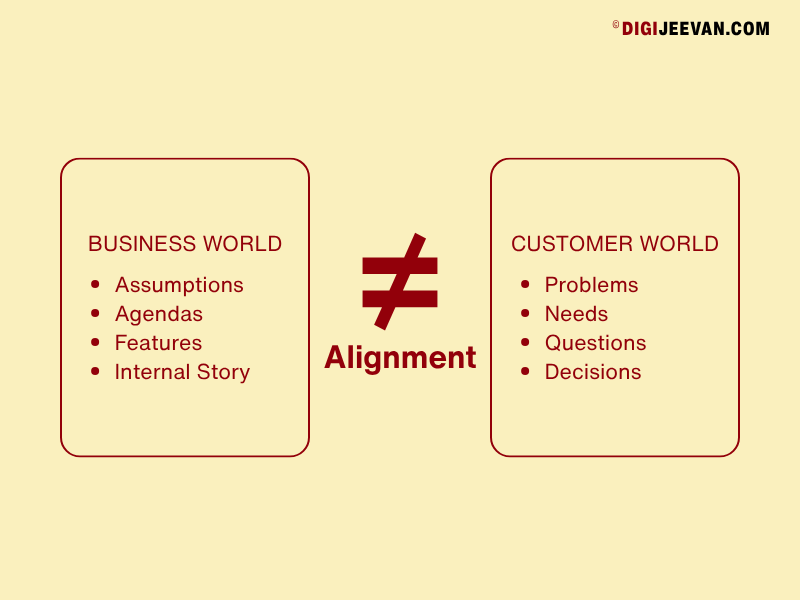
More often, it breaks because the business is trying to solve a different problem than the customer is trying to solve.
Over the years, I’ve noticed a recurring pattern across industries. Businesses often build campaigns around internal assumptions, product strengths, and carefully crafted messaging before validating whether those ideas reflect what customers are actually thinking.
A real estate developer talks about amenities, while buyers are questioning the future of the location. A healthcare brand presents scientific evidence, while surgeons are wondering how it changes their clinical decisions. A website introduces the company, while visitors are simply trying to find a solution to their problem.
None of these businesses lacked marketing.
They lacked alignment with market reality.
That’s why, before recommending any campaign or channel, I ask one question:
“Are we solving the customer’s actual problem, or the problem we assume they have?”
I’ve found that the answer to this single question often changes everything that follows – messaging, customer journeys, channel strategy, and ultimately, business outcomes.
Growth doesn’t usually break at execution.
It breaks much earlier, when assumptions quietly replace understanding.
The Alignment Gaps I Look For
Every disconnect is a failure to see inter-connected systems.
As I’ve worked across different industries, I’ve noticed something interesting.
The challenges may look different on the surface, but the reasons growth slows down are often surprisingly similar. It rarely comes down to a single campaign or channel. More often, it’s because one important decision stops connecting naturally to the next.
Over time, I’ve found myself asking the same questions in almost every engagement – not because they’re part of a checklist, but because they consistently reveal where growth is breaking.
1. Business Goals ≠ Qualified Audience
Have we clearly defined the business outcome we’re trying to influence, and are we focusing our efforts on the people who actually influence that outcome?
2. Customer Reality ≠ Market Research
Are we building strategy from real customer conversations and market behaviour, or from assumptions we’ve made internally?
3. Customer Needs ≠ Marketing Message
Does our communication genuinely reflect what customers are trying to solve, or are we leading with the story we want to tell?
4. Customer Journey ≠ Trust Progression
Does every interaction help customers move naturally from awareness to confidence, or are we asking them to act before they’re ready?
5. Market Perception ≠ Brand Positioning
When customers repeatedly encounter the brand, is a clear perception being formed? Do they know what the business stands for and why it’s different?
6. Brand Promise ≠ Real Experience
Does the experience consistently validate the expectations we’ve created through our marketing, sales, and communication?
I’ve learned that these gaps are rarely independent of one another.
A weak understanding of the customer eventually becomes weak messaging. Weak messaging creates fragmented journeys. Fragmented journeys lead to poor market perception. And when perception doesn’t match experience, sustainable growth becomes difficult.
That’s why I don’t treat these as isolated marketing challenges.
I see them as connected parts of the same growth system, where improving one stage strengthens everything that follows.
How I Build a Growth System?
Don’t scale confusion. Strengthen the system first.
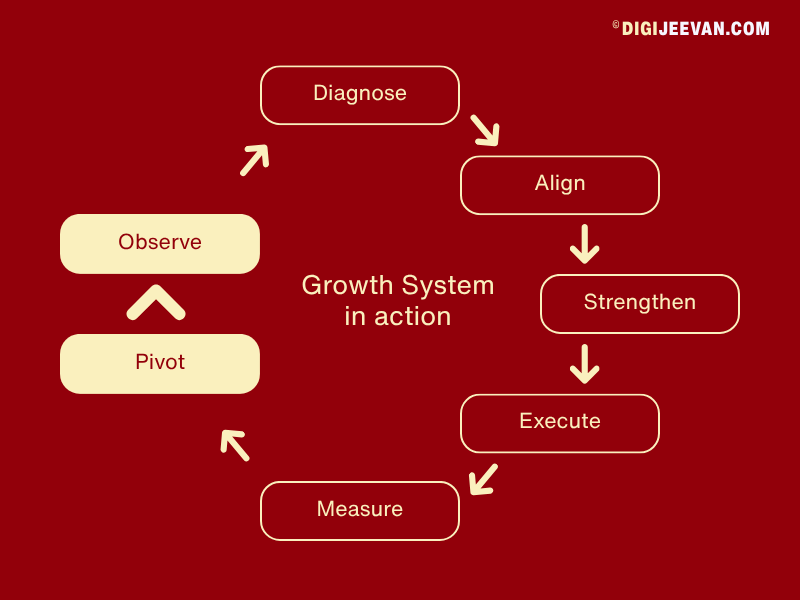
Once the diagnosis is complete, I don’t immediately start launching campaigns.
I usually begin by studying two versions of the business.
The first is the public version – its website, marketing material, social presence, campaigns, and messaging.
The second is the internal version – the strategy decks, campaign reviews, stakeholder discussions, and the conversations happening across teams. That’s often where I discover how decisions were made and where assumptions quietly entered the system.
I then compare both with the customer’s reality. I look beyond personas and dashboards to understand how customers actually speak, what they complain about, what questions they repeatedly ask, and how they make decisions.
Only then do I begin rebuilding the system.
I don’t believe growth systems are built by launching campaigns. They are built by connecting decisions that are often made in isolation.
That usually begins with bringing everyone onto the same page; to share the same understanding of the customer, the business objective, and where growth is currently breaking. When every team is working towards a different interpretation of the problem, even good marketing struggles to create lasting results.
From there, I focus on the moments where customers actually decide whether they trust the business. What happens after they submit a form? What does the first email communicate? Does the salesperson continue the same conversation that marketing started? Does every interaction increase confidence, or does it force the customer to start thinking all over again?
Only after those moments are working well do I begin improving the marketing message, content, paid campaigns, and channel execution.
The reason is simple. In today’s marketing landscape, attracting attention has become easier than ever. AI can help write compelling copy. Platforms can optimise targeting. Budgets can buy more reach.
But growth rarely depends on getting more attention. The real challenge is sustaining interest, building conviction, and helping customers feel confident that they’re making the right decision. It depends on what happens after you’ve earned it.
That’s why I judge success differently.
A campaign isn’t successful because it generated clicks or conversions.
It’s successful when, months later, customers still believe they made the right decision.
And I’d rather scale a system that consistently builds trust than accelerate one that quietly loses it.
Why I Stay Close to Execution?
Execution is where assumptions meet reality.
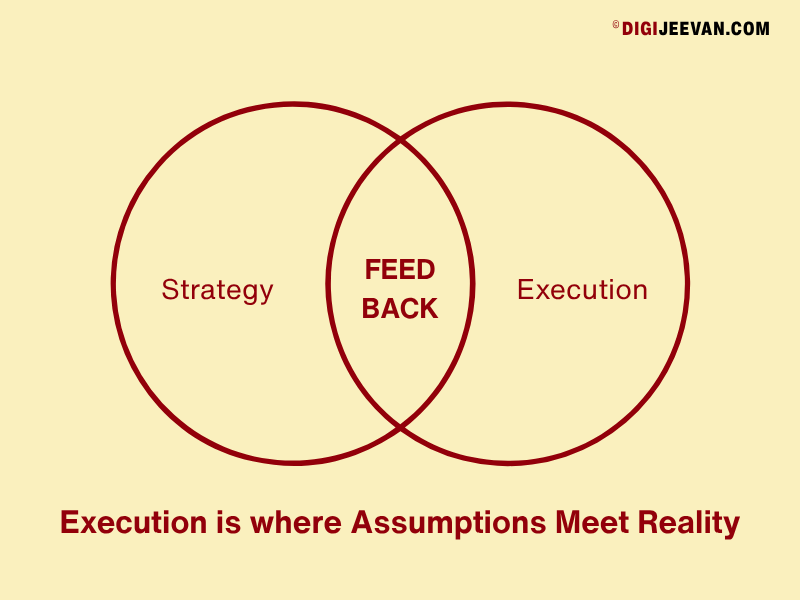
That’s why I never see strategy and execution as separate responsibilities. To me, they’re continuous feedback loops.
Strategy provides direction. Execution tests that direction against real customer behaviour. The insights from execution then refine the strategy, making every decision stronger than the one before it.
I stay close to execution because that’s where I learn the fastest.
Watching customers interact with a website, analysing campaign dashboards, listening to sales conversations, observing where people hesitate, where they click, where they leave, and where they convert – these moments reveal more than any planning session ever could. They show me where the strategy is working, where assumptions were wrong, and where the next improvement should come from.
This is also why I prefer shorter learning cycles over longer planning cycles. I’d rather discover an alignment gap in three days than continue following a six-month strategy that the market has already rejected.
For me, execution isn’t the final step after strategy.
It’s the environment where better strategy is continuously built.
That’s why I continue working closely with websites, analytics, paid media, CRM journeys, AI workflows, content, and customer experience – not because I believe leadership means doing everything yourself, but because staying connected to execution keeps strategy connected to reality.
What This Means for Your Business?
Great marketing leaves behind a smarter organization.

The goal isn’t simply to improve your marketing.
It’s to help your business make better growth decisions.
You’ll spend less time debating assumptions and more time validating them with real customer feedback. Marketing will become less about launching campaigns and more about understanding what the market is telling you.
Instead of optimising isolated channels, your teams will begin connecting business objectives, customer research, messaging, execution, and feedback into one continuous growth system. Each decision will naturally strengthen the next, making it easier to identify where growth is slowing down and where it should be improved.
Over time, your organisation will shift from thinking in campaigns and funnels to thinking in systems and feedback loops. Customer insights won’t remain within the marketing team – they’ll influence strategy, sales, customer experience, and future decision-making across the business.
Most importantly, you’ll build an organisation that learns faster.
One that doesn’t wait months to discover whether a strategy worked, but continuously listens, adapts, and improves as customers respond.
Because sustainable growth isn’t created by a single successful campaign.
It’s created by a business that gets better at learning from every customer interaction.
None of these ideas came from textbooks.
They emerged gradually while working across real estate, healthcare, waste management, omnichannel marketing, employer branding, and digital transformation.
Every project challenged an assumption I previously held. Every successful outcome refined the way I think today.
If you’re curious about that journey, you can read more here.